Current translation:

OP’s version is more poetic
I agree. Translation is much better these days and I am sure someone else was going to be curious about what the actual translation was.
Good they fixed it but I wouldn’t be surprised if it broke again. Once I was doing a coding project that involved Google Translate and I was using the same sentences for testing. In a week translation has changed 3 times, from bad to good to bad.
Out of curiosity, did it change back to the previous bad translation, or create a new bad translation?
Might not be an accurate translation but it still speaks the truth. Unfortunately there aren’t many ways of avoiding the future.
deleted by creator
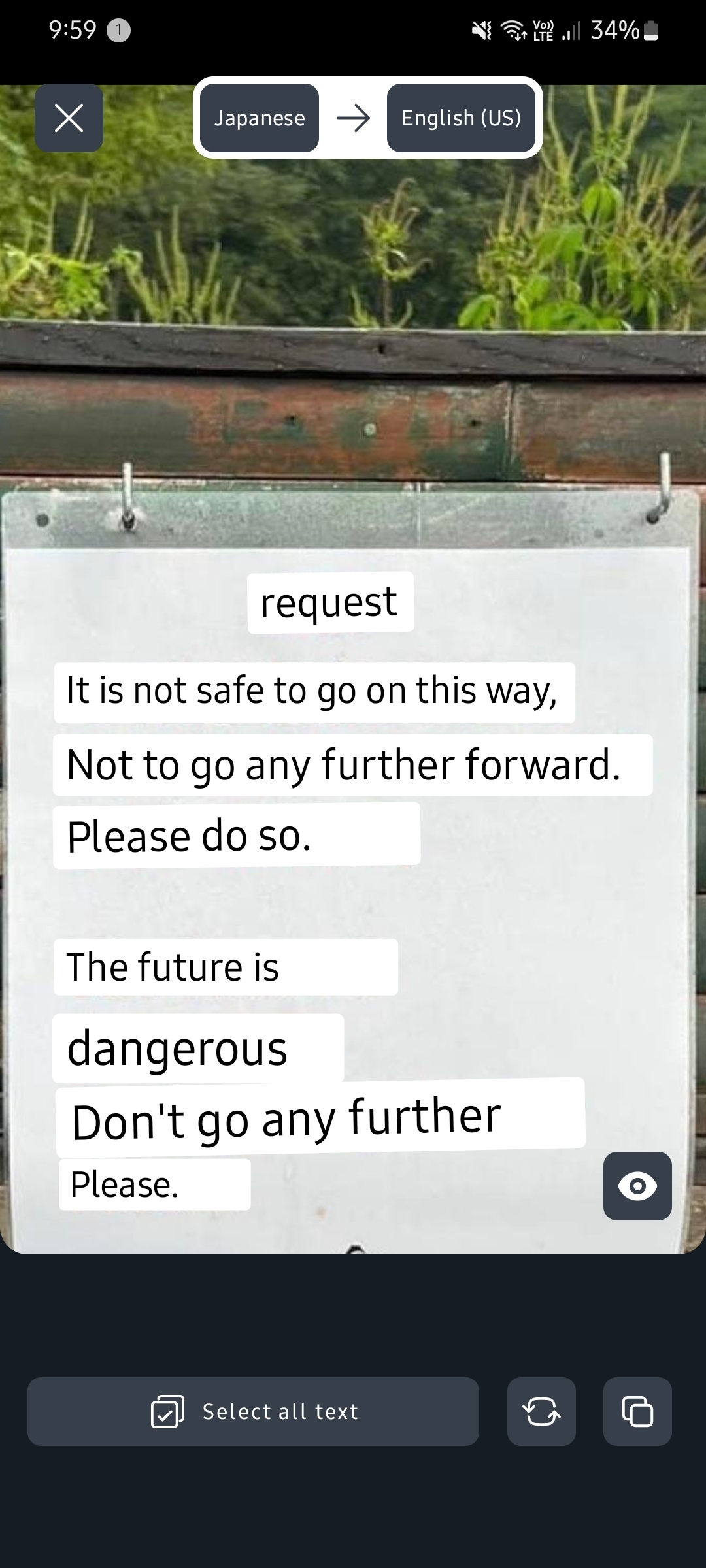
It seems like the sign is trying to kill me in this translation.
deleted by creator
Yeah, it’s the android version.
To be fair, It looks like a problem with the OCR from the app rather than the translation. When I use the phone’s native OCR and copy/paste the text into DeepL Translate, I get the same result as you.
deleted by creator
This problem stems from この先 being able to mean “ahead from here in space”, or in time which (mis)translated to “the future”. Without proper context (that it is a sign on a road) the translation software had to make a guess, and it guessed wrong.
It may be possible to infer from 前へ行く in the second sentence that it is more likely referring to space than time, but I still think it is possible to construct some similar sentences which even humans might misunderstand.